

Traditional PRP Systems vs. ExoCube™
Beyond Platelet Concentration
As regenerative medicine continues to evolve, platelet-rich plasma (PRP) has become one of the most widely used autologous biologic therapies. Conventional PRP systems are designed to separate and concentrate platelets from whole blood, providing a practical and well-established method for delivering platelet-derived growth factors to target tissues.
However, platelet concentration represents only one component of the biological environment involved in tissue repair.
While platelets are important reservoirs of growth factors and regenerative mediators, tissue repair involves a complex network of platelet-derived mediators, plasma-derived regulatory proteins, cytokines, soluble signaling molecules, and naturally occurring extracellular vesicle (EV)-sized particles. This broader collection of bioactive molecules is commonly referred to as the autologous secretome. [4,5,7,9]
Traditional PRP Systems
Traditional PRP systems prepare platelet-rich plasma through centrifugation, concentrating platelets from whole blood.
Depending on the system, the final PRP may be leukocyte-poor or leukocyte-rich (neutrophil-poor/neutrophil-rich), low-volume or high-volume, and moderately concentrated or highly concentrated. Comparative studies have demonstrated considerable variability among commercial systems in platelet concentration, leukocyte content, red blood cell contamination, cytokine profiles, and growth factor composition. [2,3,6]
While highly effective for platelet enrichment, the final biological composition of PRP can vary depending on patient baseline values, blood draw volume, centrifugation protocol, leukocyte content, activation method, and collection technique. [1,2,3,6] Conventional PRP systems are not designed to concentrate the broader plasma secretome beyond the platelet-rich fraction.
ExoCube™: A Next-Generation Biological Strategy
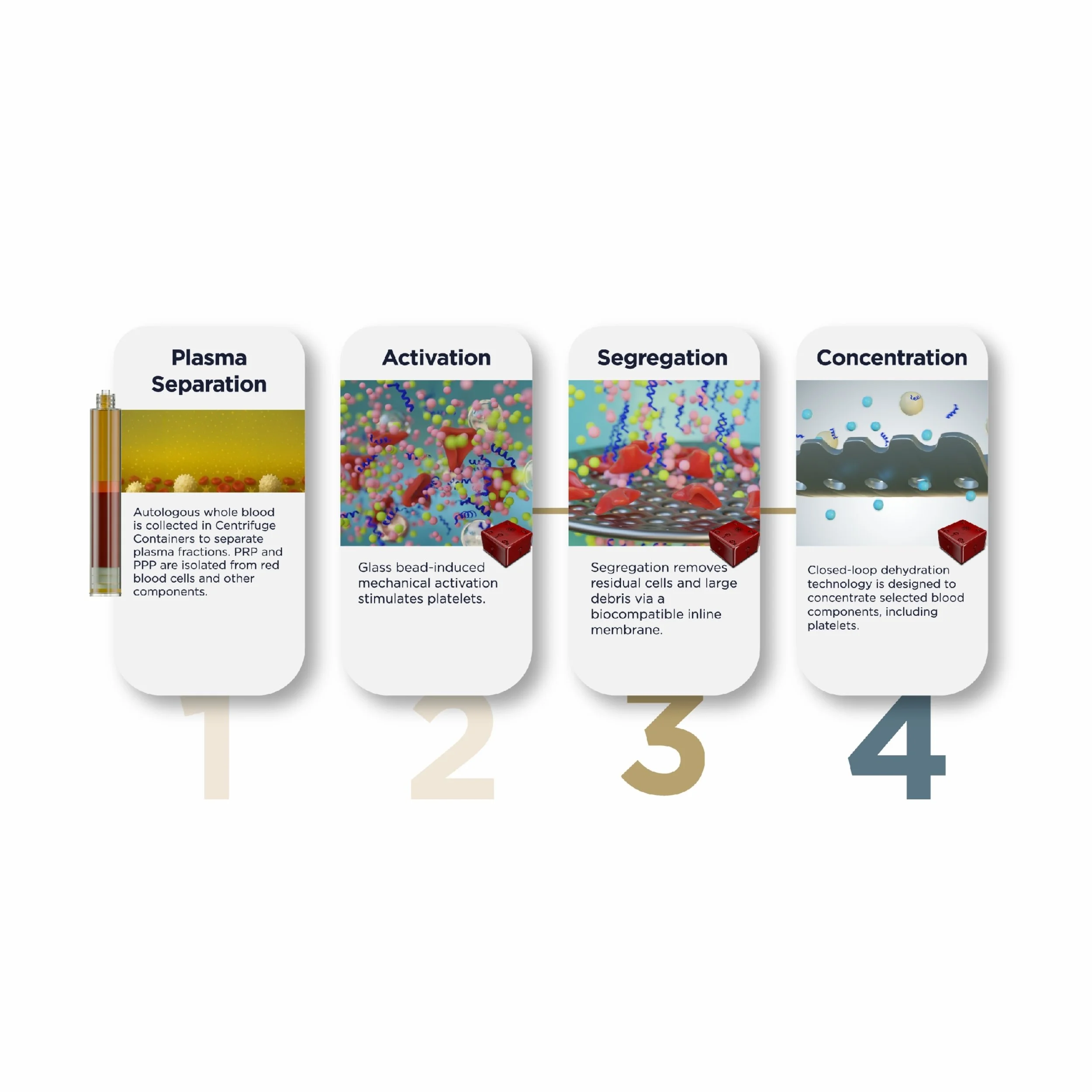
ExoCube™ integrates platelet activation, segregation, and concentration into a standardized, closed workflow that goes beyond platelet enrichment alone by increasing the deliverable autologous biological payload from blood-derived plasma. [7,8]
Activation is a meaningful component of this strategy. In addition to initiating platelet-derived growth factor release, activation, and blood-component processing may enhance the release and concentration of soluble regulatory mediators within the final product. This includes interleukin-1 receptor antagonist protein (IRAP, also known as IL-1Ra), a naturally occurring regulatory protein that competitively inhibits IL-1 signaling, a pathway associated with inflammatory and catabolic activity in joint tissues. [4,5]
The resulting biological payload is designed to include not only platelet-derived growth factors, but also plasma-derived regulatory proteins, soluble cytokines, signaling molecules, and naturally occurring extracellular vesicle-sized particles. [7,8,9]
Why the Difference Matters
PRP-focused systems remain valuable tools in regenerative medicine. They provide a practical method for preparing autologous platelet-rich plasma from whole blood, with strengths in platelet enrichment, ease of use, and compatibility with point-of-care clinical workflows.
However, tissue repair is coordinated by multiple biomediators acting together within the autologous secretome. These components may contribute to modulating inflammation, matrix protection, angiogenesis, cellular migration, immune signaling, and extracellular matrix remodeling. [4,5,7,9,10] Many of these mediators are not the primary target of conventional PRP preparation and may not be present in the same abundance within a platelet-rich fraction alone. ExoCube™ is designed to activate, filter, and concentrate a broader secretome, selectively increasing the deliverable concentration of platelet- and plasma-derived biological components beyond what platelet enrichment alone can achieve.
For example, platelet-derived growth factors may support cell proliferation and angiogenesis, while plasma-derived regulatory proteins such as alpha-2-macroglobulin may contribute to anti-catabolic activity by inhibiting tissue-degrading enzymes. [10] Other mediators, including HGF, IGF, and IRAP, may support tissue repair, cell survival, and modulation of inflammatory pathways. [4,5]
Different Methods. Different Biological Outputs.
Traditional PRP systems are designed to prepare platelet-rich plasma, whereas ExoCube™ employs a distinct biological strategy that combines platelet activation, segregation, and concentration to generate a broader autologous secretome. ExoCube™ is designed as an autologous secretome concentration platform to move beyond platelet enrichment alone and increase the deliverable biological payload from blood-derived plasma. [7,8,9]
Citations
Mazzocca AD, McCarthy MBR, Chowaniec DM, et al. Platelet-rich plasma differs according to preparation method and human variability. J Bone Joint Surg Am. 2012;94(4):308-316. doi:10.2106/JBJS.K.00430
Oudelaar BW, Peerbooms JC, Huis In ’t Veld R, Vochteloo AJH. Concentrations of blood components in commercial platelet-rich plasma separation systems: a review of the literature. Am J Sports Med. 2019;47(2):479-487. doi:10.1177/0363546517746112
Dejnek M, Moreira H, Płaczkowska S, et al. Content of blood cell components, inflammatory cytokines and growth factors in platelet-rich plasma obtained by various commercial systems. Biology (Basel). 2022;11(8):1184. doi:10.3390/biology11081184
Everts PA, Knape JTA, Weibrich G, et al. Angiogenesis and tissue repair depend on platelet-derived growth factors. Biomedicines. 2023;11(7):1922. doi:10.3390/biomedicines11071922
Patel H, et al. A comprehensive review on platelet-rich plasma activation: a key player in accelerating skin wound healing. Cureus. 2023;15:e48943. doi:10.7759/cureus.48943
Tey RV, Haldankar P, Joshi VR, Raj R, Maradi R. Variability in platelet-rich plasma preparations used in regenerative medicine: a comparative analysis. Stem Cells Int. 2022;2022:3852898. doi:10.1155/2022/3852898
Welsh JA, Goberdhan DCI, O’Driscoll L, et al. Minimal information for studies of extracellular vesicles (MISEV2023): from basic to advanced approaches. J Extracell Vesicles. 2024;13:e12404. doi:10.1002/jev2.12404
Busatto S, Vilanilam G, Ticer T, et al. Tangential flow filtration for highly efficient concentration of extracellular vesicles from large volumes of fluid. Cells. 2018;7(12):273. doi:10.3390/cells7120273
Anitua E, Rimal R, Alkhraisat MH. Advances in platelet rich plasma-derived extracellular vesicles for regenerative medicine: a systematic-narrative review. Int J Mol Sci. 2023;24(17):13043. doi:10.3390/ijms241713043
Wang S, Wei X, Zhou J, et al. Identification of alpha 2 macroglobulin as a master inhibitor of cartilage-degrading factors that attenuates the progression of posttraumatic osteoarthritis. Arthritis Rheumatol. 2014;66(7):1843-1853. doi:10.1002/art.38576
07/18/2026